Summary
- Names
-
- TaM = Turnaround Module
- CaM = Cadential Module
- HaTaM / HaCaM = first halves (hence ‘Ha’)
- Basic Reduction
- Harmony is reduced to two event types:
- tonic = 0
- non-tonic = 1
- Harmonic motion is reduced to two orientations:
- away from the tonic (‘tonic-diverging’) → tonic space → [ 0— ]
- toward the tonic (‘tonic-directed’) → non-tonic space → [ 1— ]
- Phrase Modules
- Phrase modules are hypermetrical spans (S = 2 bars, M = 4 bars, L = 8 bars) defined by harmonic rhythm within the hypermetrical framework.
- There are four elementary phrase modules:
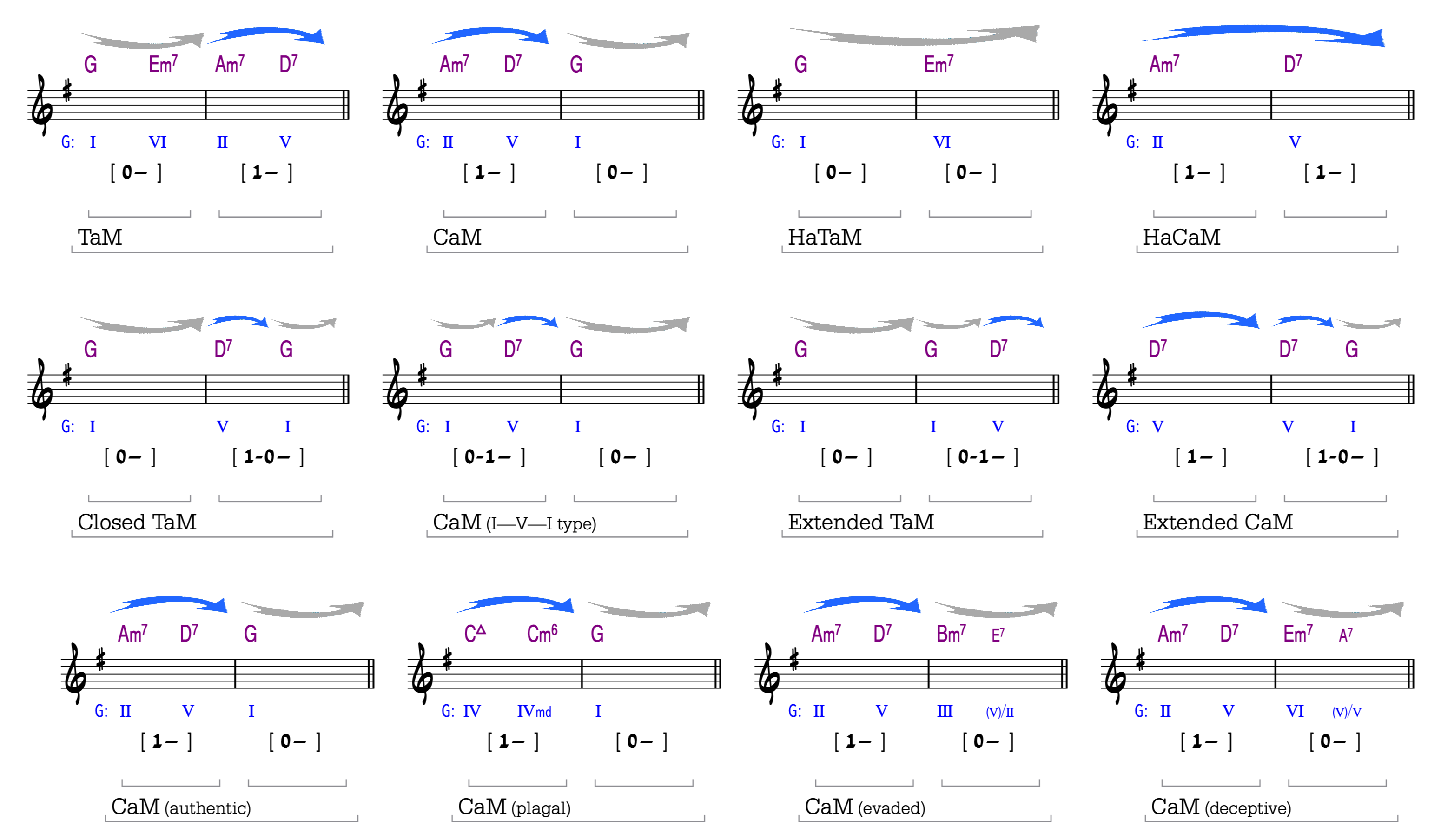
- TaM: [ 0—1— ] — tonic → non-tonic
- CaM: [ 1—0— ] — non-tonic → tonic
- HaTaM: [ 0— ] — tonic space
- HaCaM: [ 1— ] — non-tonic space
- The CaM is the only elementary phrase module that provides harmonic closure. All others are ‘open’.
- Standard Jazz Prototypes
-
- TaM: I—VI—II—V
- CaM: II—V—I
- Internal Structure
- Binary modules consist of two unary halves:
- TaM = HaTaM—HaCaM
- CaM = HaCaM—HaTaM
- Common Compound Forms
-
- Closed TaM = HaTaM—CaM
- I—V—I / I—IV—I CaM = TaM—HaTaM
- Extended TaM = HaTaM—TaM
- Extended CaM = HaCaM—CaM
- Cadential Types (CaM)
-
- authentic (V—I)
- plagal (IV—I)
- evaded (V—III → no resolution)
- deceptive (V—VI → unexpected resolution)
- Primary vs Secondary
-
- primary: relates to global tonic (I)
- secondary: relates to local tonic (e.g. CaM/V, TaM/II)
- Analytical Principle
- Harmonic meaning depends on position within the hypermetrical framework, not on chords alone. The same progression may function differently depending on where it occurs.
- All phrase modules are combinations of ‘0’ and ‘1’ in hypermetrical time.
- Exemplars
-
- My Little Suede Shoes — S-level CaMs throughout
- Autumn Leaves — M-level CaMs minor / relative major
- Blue Moon — S-level TaMs (A); Primary & Secondary CaMs (B)
- A Foggy Day — M-level TaMs; different sizes TaMs (C)
- Secret Love — Extended TaM & CaM
- There’s a Small Hotel — Secondary TaMs
Introduction
In this chapter—the first of four in the TaMs & CaMs schema ‘book’—the elementary building blocks of Phrase Module Theory are introduced: the binary phrase modules TaM and CaM, alongside their respective first halves, the unary phrase modules HaTaM (the first half of a TaM) and HaCaM (the first half of a CaM).
The second chapter, TaMs & CaMs — Contrapuntal Framework, is dedicated exclusively to the modelling of the tonal material that makes up these elementary building blocks.
The third and fourth chapters, TaMs & CaMs — TaMs & HaTaMs and TaMs & CaMs — CaMs & HaCaMs, discuss the respective phrase modules in more detail.
Harmonic Events
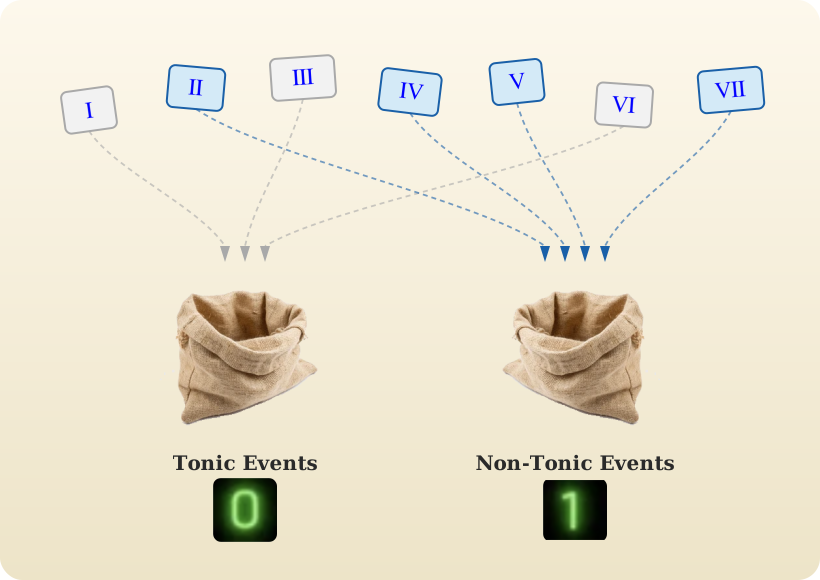
Harmonic events are reduced to two categories: tonic and non-tonic. In digital terms, tonic corresponds to an ‘off’ or ‘0’ event, non-tonic to an ‘on’ or ‘1’ event.
- tonic → ‘0’
- non-tonic → ‘1’
As a first step, harmonic events may be understood as individual chords. In this sense, chords with tonic function are ‘0’ events—typically I, VI, and III—whereas chords with dominant or subdominant function are ‘1’ events—typically II, V, IV, and VII (the latter occurring only rarely, and usually as (II)/VI). Needless to say, the situation is ultimately more complex.
On the analogy between harmonic function and semantic meaning in speech, chords may be likened to words, which deploy their meaning only within sentences. Moreover, the function of some chords is inherently ambivalent; depending on the context, VI may assume subdominant function, just as III may take on dominant function.
Harmonic Motion
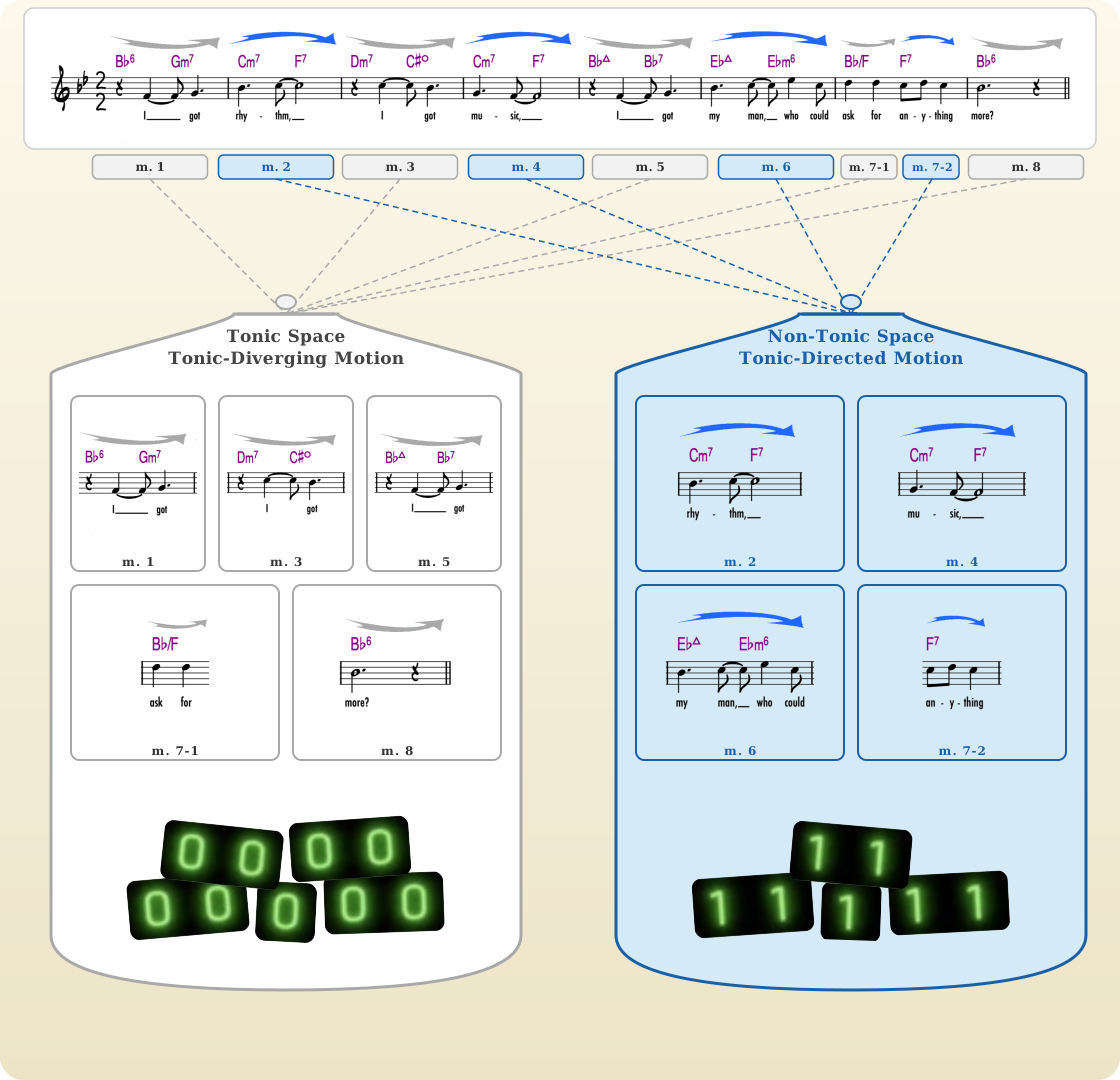
Harmonic motion is reduced to two vectorial types: motion away from the tonic and motion toward the tonic:
- motion away from the tonic → tonic-diverging → centrifugal → tonic space
- motion toward the tonic → tonic-directed → centripetal → non-tonic space
As a second step, the concept of harmonic motion needs to be addressed. In terms of spaces and events that take place in these spaces, harmonic motion may be understood as harmonic events differentiated into two categories of harmonic space: tonic space or non-tonic space; in terms of vectorial gestures, harmonic motion can be differentiated as to their orientation: driven away from tonic, resulting in tonic-diverging motion, and pulled toward tonic, resulting in tonic-directed motion. Tonic-diverging motion corresponds to centrifugal force, tonic-directed motion to centripetal force.

In perception, these harmonic motion spans are interpreted in terms of their harmonic rhythm—that is, they are parsed against the foil of the hypermetrical framework (see the section Harmonic Rhythm below). The functional categories are the two basic types of vectorial gesture introduced above: tonic-diverging—motion away from the tonic, driven by centrifugal force—and tonic-directed—motion toward the tonic, driven by centripetal force.
The metrical category concerns the length and position of the motion span. Both align with the hypermetrical framework and the time-slots it provides: 2-bar, 4-bar, and 8-bar units. These hypermetrical units, when classified according to their functional behaviour, constitute the phrase modules on which Phrase Module Theory is built.
A complementary, more static way of understanding these two types of harmonic motion is in terms of tonal space: tonic space and non-tonic space. It is crucial to note that non-tonic events may form part of the tonic space, and vice versa. This is particularly evident in the case of chords with subdominant function, which, as dominant-preparing ‘pre-dominants’ or as ‘negative dominants’, typically occur in non-tonic space, but may also act as extensions of the tonic space. Another example is provided by I–V—I CaMs—so-called “Who Could Ask for Anything More” CaMs—in which a tonic event initiates a higher-level non-tonic span.
Harmonic Rhythm
Harmony is essentially rhythmic, and harmonic rhythm is central to the perception of harmonic motion.
Harmonic rhythm is perceived against the foil of an underlying hypermetrical framework.
Harmonic rhythm is more than a mere ratio of durations of chords or spans of harmonic space; it is inseparable from their position within that framework.
There is no unequivocal definition of harmonic rhythm, even among (jazz) music theorists. For some, it refers simply to the number of chords per measure; for others, to the ratio of chord durations alone. This conceptual ambiguity becomes evident in discussions of the proverbial II—V—I progression. While there is broad implicit agreement that this progression presupposes a specific metrical configuration—II in a relatively strong position with respect to V, and II–V in a relatively strong position with respect to I—these features are often treated as statistical tendencies rather than as structural requirements.
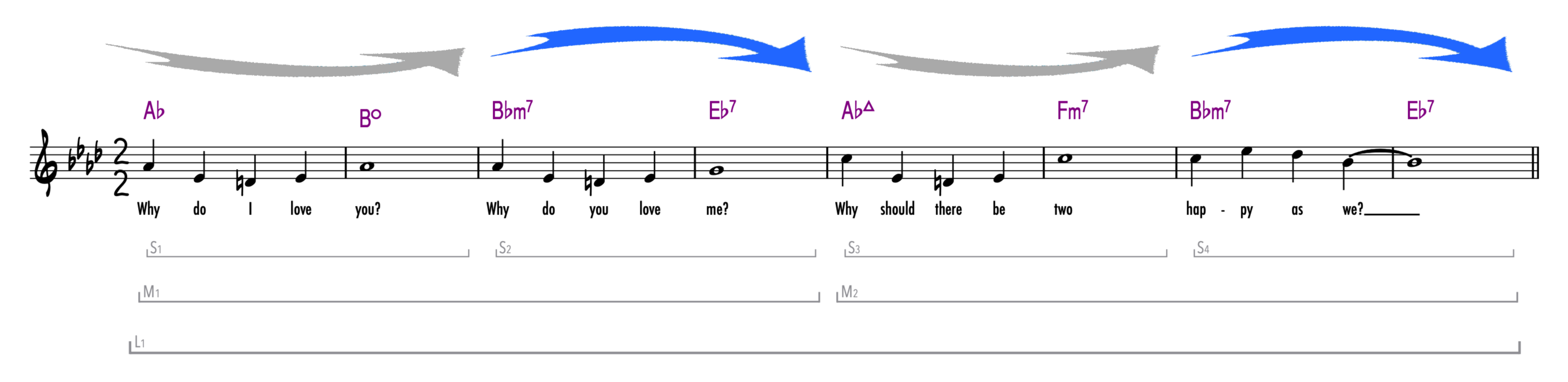
Phrase Module Theory regards a II—V—I progression as a phrase module. To qualify as such, it must occupy an entire hypermeasure. In the analytical examples, two-bar hypermeasures are labelled S1, S2, etc.; four-bar hypermeasures M1, M2; and eight-bar hypermeasures L1, L2.
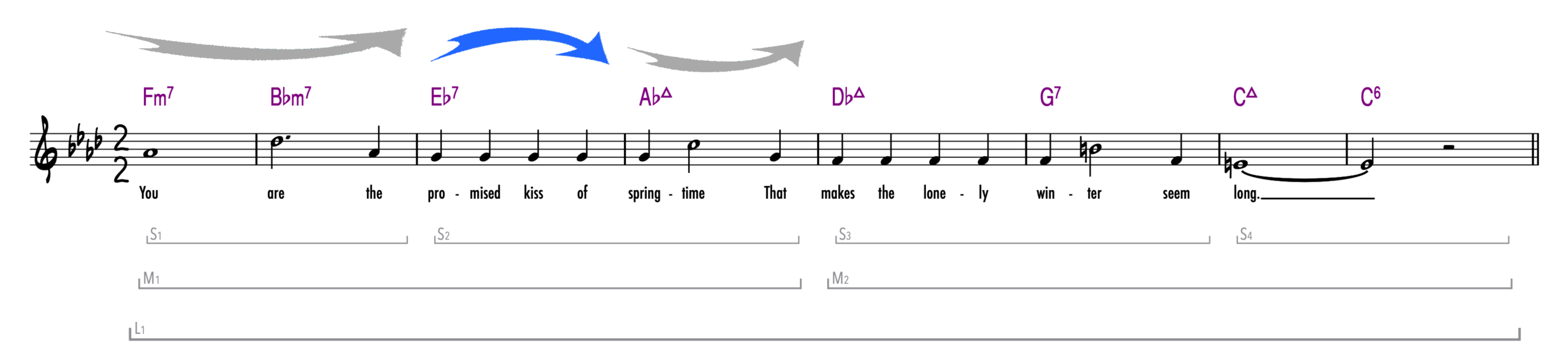
Examples 2a–2c present the A sections of three American Songbook standards in the same key, each featuring the chords B♭m7, E♭7, and A♭̂ of identical duration and order, but positioned differently within the eight-bar phrase. Only Don’t Worry ‘Bout Me satisfies the structural criterion of a phrase module: each of its two II–V–I progressions occupies a complete M-level hypermeasure (M1 and M2 respectively).
In Why Do I Love You, the II–V occupies S2 and the I occupies S3, separated by a hypermetrical boundary between M1 and M2. The II–V units in S2 and S4 therefore function as self-contained S-sized modules articulating arrival-oriented motion toward the tonic.
In All the Things You Are, even the II and V do not share the same small hypermeasure. The II chord belongs to S1, which functions as a I–IV (in F minor) or VI–II (in A♭ major) module articulating tonic–subdominant motion—that is, departure from the tonic. By contrast, the V and I form a dominant–tonic gesture articulating arrival at the tonic.

Hypermeter
The most basic metrical hierarchy is binary, consisting of the relation between downbeat and upbeat. Its fundamental unit is a pair of equally long events—either downbeat followed by upbeat, or vice versa. When this unit is repeated, a higher metrical level emerges, in which successive downbeats inevitably come to assume unequal roles, one functioning as relatively strong and the other as relatively weak. In this way, a hierarchical, tree-like structure arises.
This tree structure is reflected in exemplary fashion in the system of note values. In Figure 4, the five principal note values (whole, half, quarter, eighth, and sixteenth note) are shown not only in terms of their relative durations—which are equal within each level—but also in terms of their relative metrical weight, which is hierarchically differentiated. At the level of half notes there are two degrees of weight; at the level of quarter notes, three; at the level of eighth notes, four; and at the level of sixteenth notes, five.

If the quarter note functions as the reference unit in music notation, the eight-bar phrase serves as the corresponding reference unit in most Western popular-music styles. Figure 5 illustrates the hypermetrical structure of such an eight-bar phrase. Three levels of brackets are placed beneath the staff, with the largest unit (eight bars) at the bottom, the intermediate unit (four bars) in the middle, and the smallest unit (two bars) at the top.
These units are hypermeasures labelled according to their relative lengths as L (large), M (medium), and S (small). Within the eight-bar structure, three degrees of weight can be distinguished: the strongest weight falls on L1, M1, and S1; an intermediate weight on M2 and S3; and the weakest on S2 and S4.

Phrase Modules
Phrase modules are hypermetrical time spans—typically 2-bar (S), 4-bar (M), or 8-bar (L) hypermeasures—defined by a specific harmonic-rhythmic profile.
There are four elementary phrase modules, two binary (TaMs and CaMs) and two unary (HaTaMs and HaCaMs).
- TaM: tonic on the rhythmically strong first half → [ 0—1— ] → a span of tonic-diverging motion followed by tonic-directed motion
- CaM: tonic on the rhythmically weak second half → [ 1—0— ] → a span of tonic-directed motion followed by tonic-diverging motion
- HaTaM: tonic events → [ 0— ] → a span of tonic space or tonic-diverging motion
- HaCaM: non-tonic events → [ 1— ] → a span of non-tonic space or tonic-directed motion
Binary Phrase Modules: TaMs & CaMs
TaMs and CaMs are the two fundamental phrase modules that contain both types of harmonic motion. They may be classified as authentic or plagal, depending on the function of the final non-tonic harmony within the non-tonic motion span—dominant or subdominant, respectively. Plagal TaMs and CaMs are labelled TaMpl and CaMpl.
In standard jazz harmony, the two principal exemplars of TaMs and CaMs are the proverbial I—VI—II—V and II—V—I progressions, respectively.
Unary Phrase Modules: HaTaMs & HaCaMs
The concept of unary modules merits brief clarification. On the one hand, they correspond to the two types of harmonic events: HaTaM to tonic, HaCaM to non-tonic. On the other hand, as phrase modules, they represent the two segments that together constitute the binary modules.
In most cases, they do not require explicit mention—or labelling—in phrase-module analysis. By definition, a TaM consists of a HaTaM followed by a HaCaM; conversely, a CaM consists of a HaCaM followed by a HaTaM. In certain asymmetrical compound phrase modules, however, unary modules assume the status of binary modules—for example, in the Closed TaM (HaTaM—CaM) or the Open “Prinner” (CaM—HaCaM).
Basic Two-Chord TaMs & CaMs
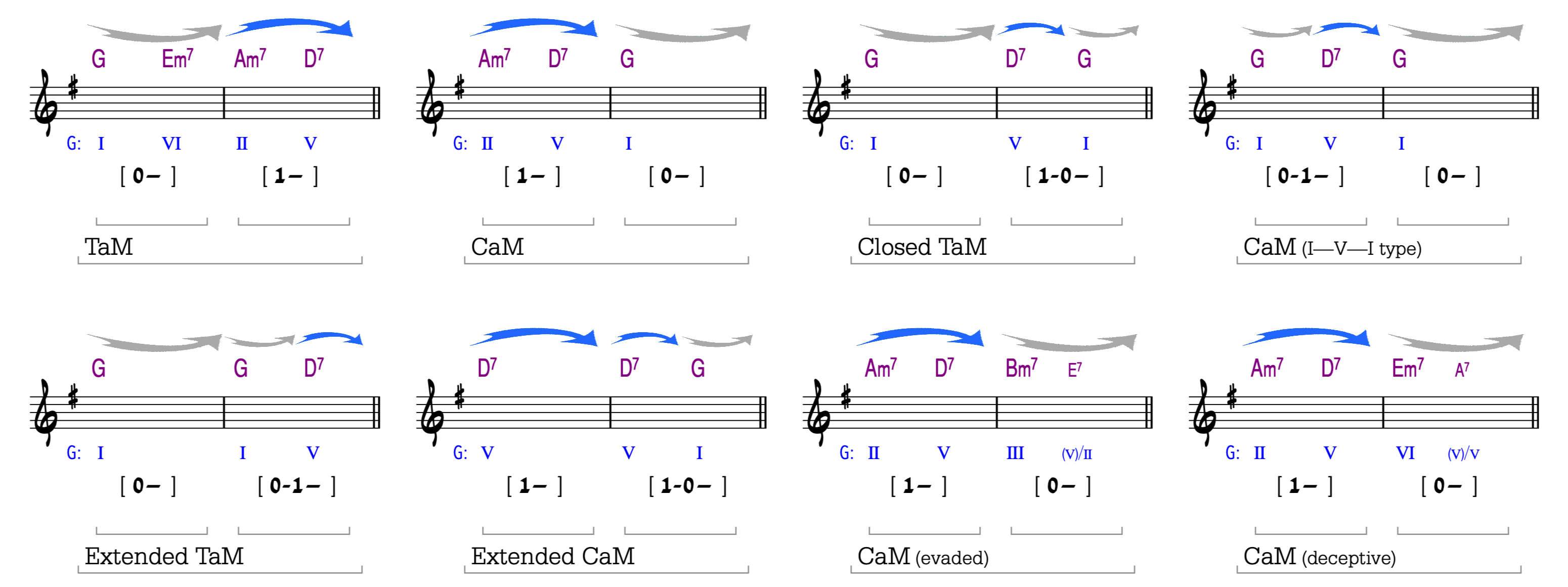
Examples 3a and 3b show the most basic primary-colour two-chord TaMs and CaMs as two-bar chord progressions (S modules): the authentic variants feature I and V, the plagal ones I and IV.


Common Four-Chord TaMs & CaMs
The following three examples present a number of common four-chord TaMs and CaMs. Example 4a features the most proverbial instances: the I—VI—II—V TaM—rendered in ‘doo-wop’ style as I—VI—IV—V—and the II—V—I CaM.
Example 4b shows variants in which (V)/V substitutes for II. Example 4c presents the most representative plagal TaMs and CaMs, featuring the diatonic IV in combination with their Moll–Dur and Dur–Moll variants.


Evaded and Deceptive CaMs
The concepts of evaded and deceptive CaMs align closely with those of evaded and deceptive cadences.
- Evaded CaMs lack resolution: the guide tones do not resolve. In practice, this typically results in II—V—III—VI or similar progressions.
Remember: Evaded CaM = V—III. - Deceptive CaMs do involve resolution: the guide tones resolve, but to an unexpected harmony. In practice, most clearly exemplified by II—V—VI progressions.
Remember: Deceptive CaM = V—VI.
Example 5 presents instances of evaded and deceptive CaMs in both major and minor. For a more technical account of the underlying mechanisms, see the chapter TaMs & CaMs — Contrapuntal Framework.

Cases with Asymmetrical Phrase-Modular Constellation
This section addresses three ‘special’ cases. Their specialness lies in the fact that they are often grouped with binary phrase modules, yet upon closer inspection they exhibit an asymmetrical distribution of harmonic events: two on one side and one on the other.
The I—V—I and I—IV—I CaMs (Example 6a) contain a lower-level ‘cadential’ TaM in their first half, yielding a TaM—HaTaM constellation. The Closed TaMs (Example 6b), by contrast, contain a lower-level CaM in their second half, resulting in a HaTaM—CaM constellation. A third case involves a HaCaM formed by a (plagal) CaM followed by a HaCaM, as in the “Whisper Not” progression and the Open “Prinner” (Example 6c).


Harmonic Clave
By analogy with the Afro-Cuban son and rumba claves, the concept of harmonic clave may help to describe regularities and irregularities in harmonic rhythm. Two basic patterns can be distinguished: 3—2 and 2—3, describing the metrical orientation of two complementary sides.
Applied to harmony, we may similarly distinguish between 1—0 and 0—1 claves (‘1’ = non-tonic, ‘0’ = tonic), corresponding to the harmonic-rhythmic profiles of CaMs and TaMs, respectively. Certain schemas exhibit regular harmonic-clave patterns—for example, the A sections of Blue Moon (0—1). More often, however, changes of harmonic clave serve as a contrasting device, as in the B section of Blue Moon, where the harmonic clave switches to 1—0.
Primary and Secondary TaMs and CaMs
Primary TaMs and CaMs relate to the main—‘global’—tonal centre (I), whereas secondary TaMs and CaMs are related to local key centres. As with secondary dominants in Roman-numeral analysis, secondary TaMs and CaMs are indicated with a slash followed by the Roman numeral of the local key center, e.g. TaM/III or CaM/V.
Example 7a presents an eight-bar phrase consisting of four consecutive CaMs: the first is primary, the second, third, and fourth are secondary. Example 7b contains three consecutive secondary TaMs. Example 7c illustrates minor-major parallelism, where the movable-Do names ‘La’ and ‘Do’ may replace Roman numerals to capture the ambivalence between relative minor and major.
In phrase-module analysis, multiple interpretations of the harmonic ‘behaviour’ are not only possible but also appropriate in order to do justice to functional ambivalence and ambiguity. The question is not whether it is the one or the other, but whether it may be both. Ultimately, it is the analyst’s perception and judgement that determine which reading is most convincing.


Modulating TaMs
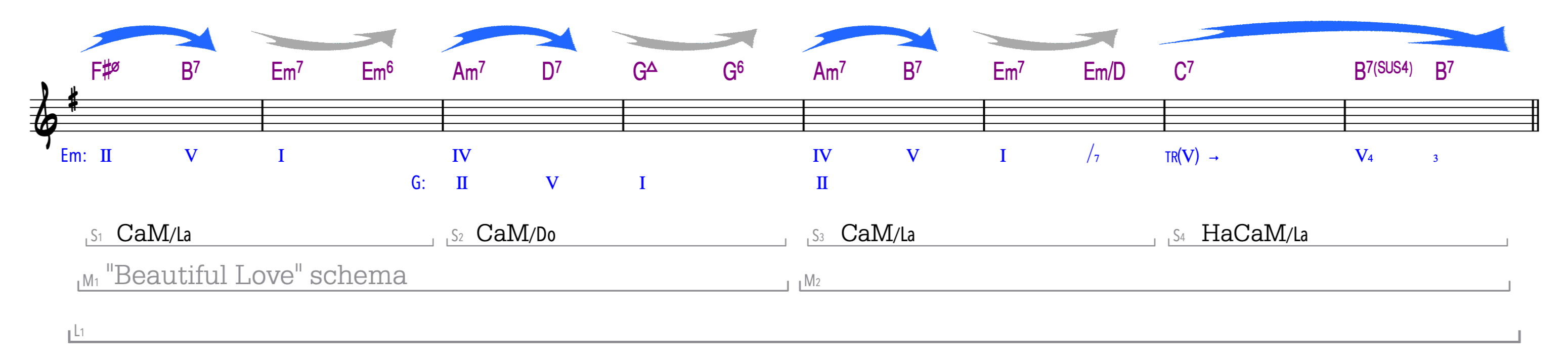
Since the TaM is an ‘open’ phrase module—not ‘closed’ by a CaM—this openness allows for a multitude of ways of filling the second half. A modulating TaM functions like a regular TaM, with the difference that the non-tonic space in the second half points towards a key centre other than that of the tonic space in the first half.
A clearer example of actual modulation is the B section of Stella by Starlight, where two consecutive modulating—in the original harmonization, plagal—TaMs move the harmony from the main key via the mediant to the dominant key (Example 8a). The opening four-bar phrase of Don’t Blame Me provides a further case in point (Example 8b).
It should be clear that local analysis of this kind is only meaningful insofar as it elucidates the underlying harmonic-functional mechanisms. The purpose of phrase-modular analysis is precisely to render such lower-level readings redundant, as long as the relevant components are implied and thus analytically evident.


Cadential (and Post-Cadential) TaMs
Cadential TaMs form the first halves of I—V—I and I—IV—I CaMs (Example 6a). As a point of reference, one may think of “Who Could Ask for Anything More” (from I Got Rhythm) and “When the Saints Go Marchin’ In” as nicknames for two typical cadential CaMs (Example 9).
Another illustration is provided by the A sections of Blue Moon (Example 13a below). At the S level, these A sections consist of four consecutive TaMs (S1–4). At the L level, they group into a Closed TaM, comprising an M-sized HaTaM antecedent and an M-sized CaM consequent. Within this consequent, S3 is a ‘cadential’ TaM functioning as HaCaM, while S4 is a ‘post-cadential’ TaM functioning as HaTaM.

Equal and Unequal Modular Proportions
As a consequence of hypermetrical hierarchy, the most natural subdivision within a binary phrase module is one of equal proportions. Deviations from this norm are perceived as rhythmic profiling and typically occur only at a single lower hypermetrical level.
The most frequent unequal proportions at the level of elementary phrase modules are 3+1 and 1+3. These proportional shifts may be interpreted in two complementary ways: either as a combination of a unary and a binary phrase module, or as a front-weighted (‘extended’) or back-weighted (‘contracted’) binary module:
- TaM (ext) = HaTaM—TaM
- TaM (ctr) = TaM—HaTaM
- CaM (ext) = HaCaM—CaM
- CaM (ctr) = CaM—HaCaM
A particularly clear instance of extended TaMs and CaMs is found in the Extended “Birthday Shuttle” schema, defined by the phrase-modular constellation TaM(ext)—CaM(ext), or, at the next lower level, HaTaM—TaM—HaCaM—CaM (e.g. Secret Love, Example 15a).


Exemplars
In this section, several examples will be presented. Many of them will feature schemas that will be introduced and further explored in later chapters of this or in one of the remaining seven schema ‘books’.
My Little Suede Shoes
This Caribbean-flavoured Charlie Parker tune from 1951 is arguably the result of an encounter with two French tunes—Pedro Gomez and Le petit cireur—from the late 1940s, which Parker is said to have picked up during a brief stay in Paris in 1950.[1][2]
Suede Shoes may serve as an example of a tune with a constant harmonic clave (1—0), which means that the entire thirty-two-bar AABA form consists of sixteen consecutive S-level CaMs. Listen to Parker’s solo chorus (Audio Example 1a): from the second eight-bar phrase onwards, the rhythm section treats all S-level CaMs as repeating two-bar vamps.
In both the head and the solos, all sixteen CaMs feature the same II—V HaCaM on their metrically strong sides. As a consequence, harmonic variation has to come from what happens in the tonic-space in the remaining sixteen bars. This variation is minimal, yet highly effective. It consists of two different patterns of alternating regular and evaded CaMs: in the A sections the third CaMs are evaded (creating an a—a—b—a pattern), while in the B sections both the first and third CaMs are evaded (resulting in an a—b—a—b pattern).

For those who know Suede Shoes from lead sheets or later recordings, it may come as a bit of a surprise that, in the original 1951 recording, the use of II—V HaCaMs is continued in the bridge, where sequentially descending triad arpeggios of the melody would rather suggest a IV—III—II—I descent. The Hilton Ruiz version (Audio Example 1c) turns M5 and M6 into complete cycles of fifths.
Regardless of whether they start with IV or with II, in phrase-module analysis, M5 and M6 present textbook exemplars of the “Prinner” schema: two consecutive CaMs, typically a plagal CaM followed by an authentic one, held together by the primary guide-tone line 6̂—5̂—4̂—3̂.

In Examples 11c and 11d, the A sections of Suede Shoes and Pedro Gomez are juxtaposed, both shown with the respective primary guide-tone lines below the melody. When comparing the first four-bar phrases (M1), the melody and harmony of Pedro Gomez exhibit more phrase-modular variety: three of the four CaMs are of different types, including I—IV—I in S1 and S3, I—V—I in S2, and (V)/V—V—I in S4.
Parker, by contrast, uses the standard building blocks of bebop harmony, with the II—V—I progression being the most standard of all—reflecting a clear priority for a solid harmonic foundation over harmonic variety.


Autumn Leaves (Les feuilles mortes)
The original lyrics by Jacques Prévert were conceived as an autonomous poem, later set to music by Joseph Kosma for the film Les Portes de la nuit (1946). Johnny Mercer’s English adaptation (1947) presents a markedly simplified, more conventional sentimental tone compared to the rich imagery of Prévert’s text.
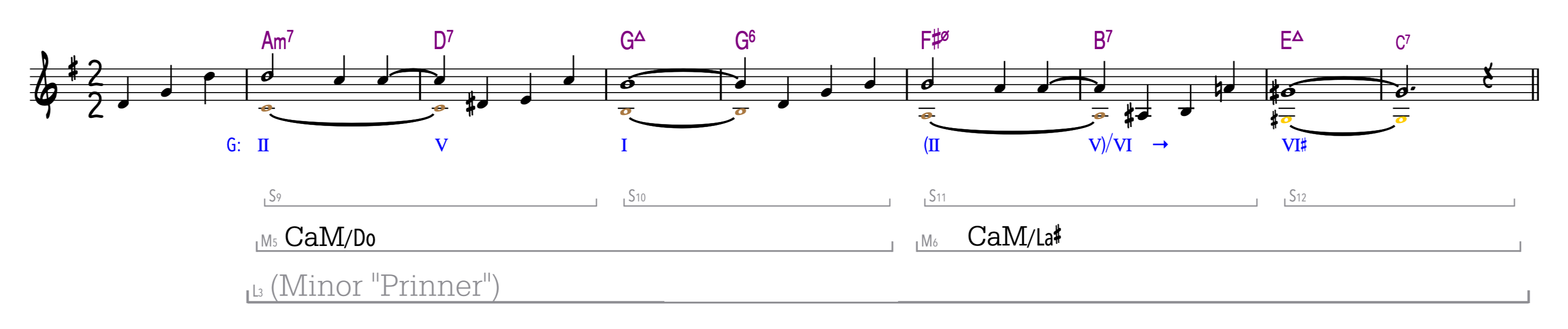
The chorus provides another example of a tune governed throughout by a consistent 1—0 harmonic clave—here, in contrast to My Little Suede Shoes, in the minor mode and at the M level. Of the eight M-sized CaMs, three are in the relative major and five in the minor tonic, labelled CaM/Do and CaM/La respectively.
Both A sections and the C section may be classified as Minor “Prinner” schemas, with the primary guide-tone line 6̂—5̂—4̂—3̂ functioning as the melodic framework as well.
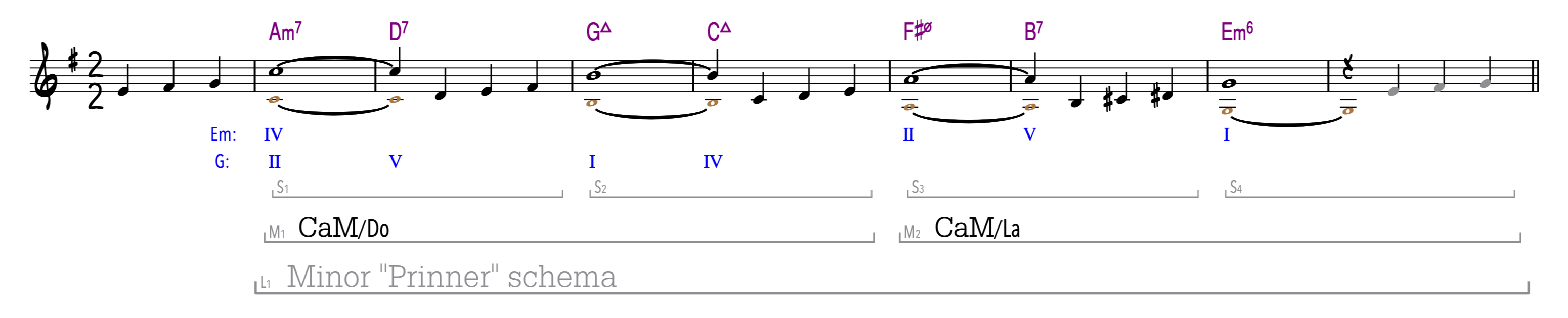
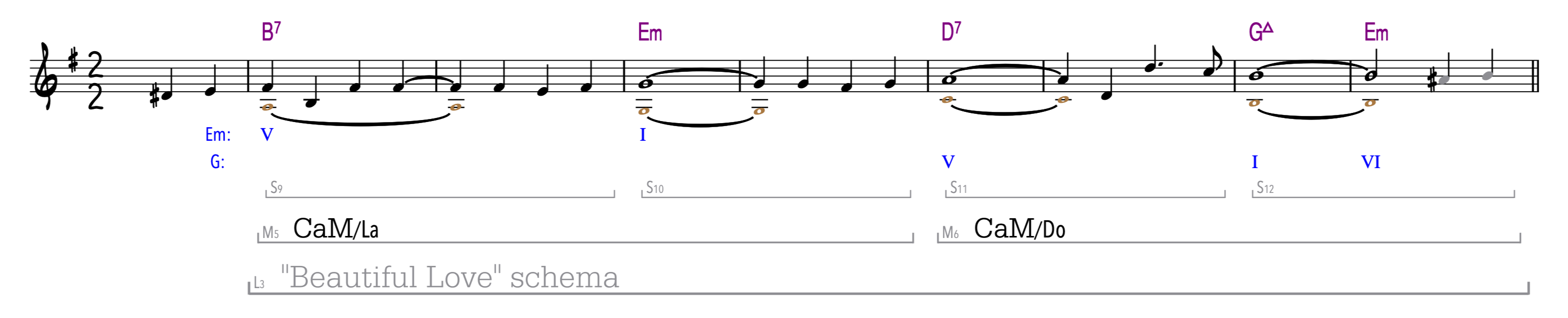

A chord progression very similar to that in the A sections of Autumn Leaves appears in the B section of All the Things You Are (Example 12d). The main difference is the key centre: in Autumn Leaves it is the minor, whereas in All the Things it is the major. The phrase-modular analysis is (almost) identical—CaM/Do—CaM/La♯—since the CaM/Do—CaM/La schema can occur in both major and minor contexts.
Blue Moon
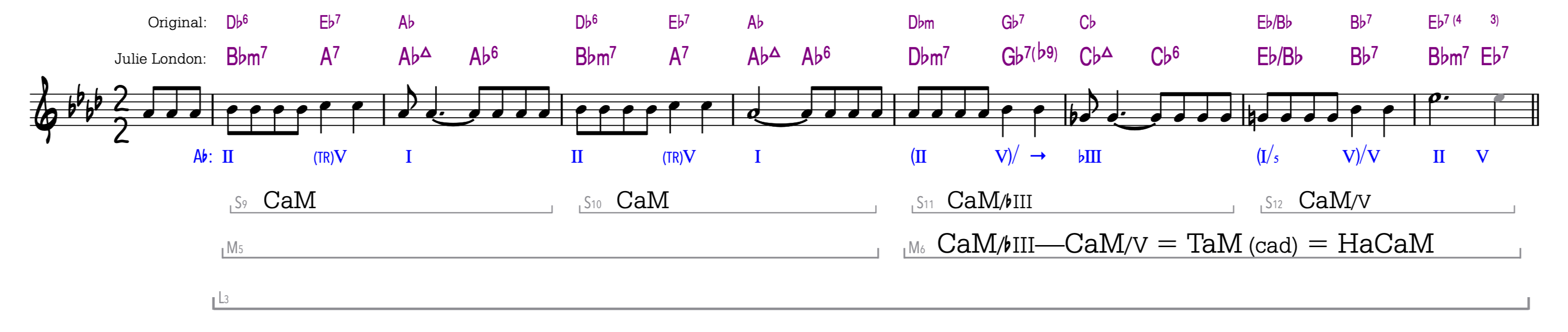
Richard Rodgers’ Blue Moon (1934) has an A section with a consistently 0—1 harmonic clave at the S level (Example 13a). While in the original sheet music the TaMs in S1, S2, and S3 are harmonically identical, in most cover versions S3 stands out as the contrasting harmonic element, often harmonized by a series of consecutive secondary dominants.
The complete eight-bar phrase forms a Large Closed TaM; as a specific schema, it serves as the prime exemplar of the “Blue Moon” schema.

In the B section, the harmonic clave switches to 1—0: while the primary CaMs S9 and S10 still prolong and confirm the tonic, the secondary CaMs S11 and S12 drift away from the tonal centre via ♭III toward V, bending the tonal space in two stages. At a deeper level, M6 behaves much like the reharmonized S3 in the A section.
A Foggy Day
The refrain (chorus) of A Foggy Day, reportedly composed by George Gershwin and his brother Ira Gershwin within the span of an after-party hour, is made up entirely of TaMs—most of them M-sized—which results in a regular 0—1 harmonic clave at the M level. In m. 29, however, the Gershwins insert two additional bars featuring a quotation of the English folk song Country Gardens, thereby extending the refrain to thirty-four bars.
These extra two bars disrupt the phrase-modular hierarchy and produce TaMs on two additional scales. The complete chorus is shown in Example 14, with the melody as published in the original sheet music. The chord symbols in smaller print represent the changes used by Oscar Peterson in his 1953 recording.

Secret Love
Secret Love, composed by Sammy Fain for the film Calamity Jane, features in its first sixteen bars the Extended “Birthday Shuttle” schema. This schema conveniently contains—within a single span (XL)—all four elementary phrase modules: HaTaM, TaM, HaCaM, and CaM, all at the same scale (M), and each occurring only once.
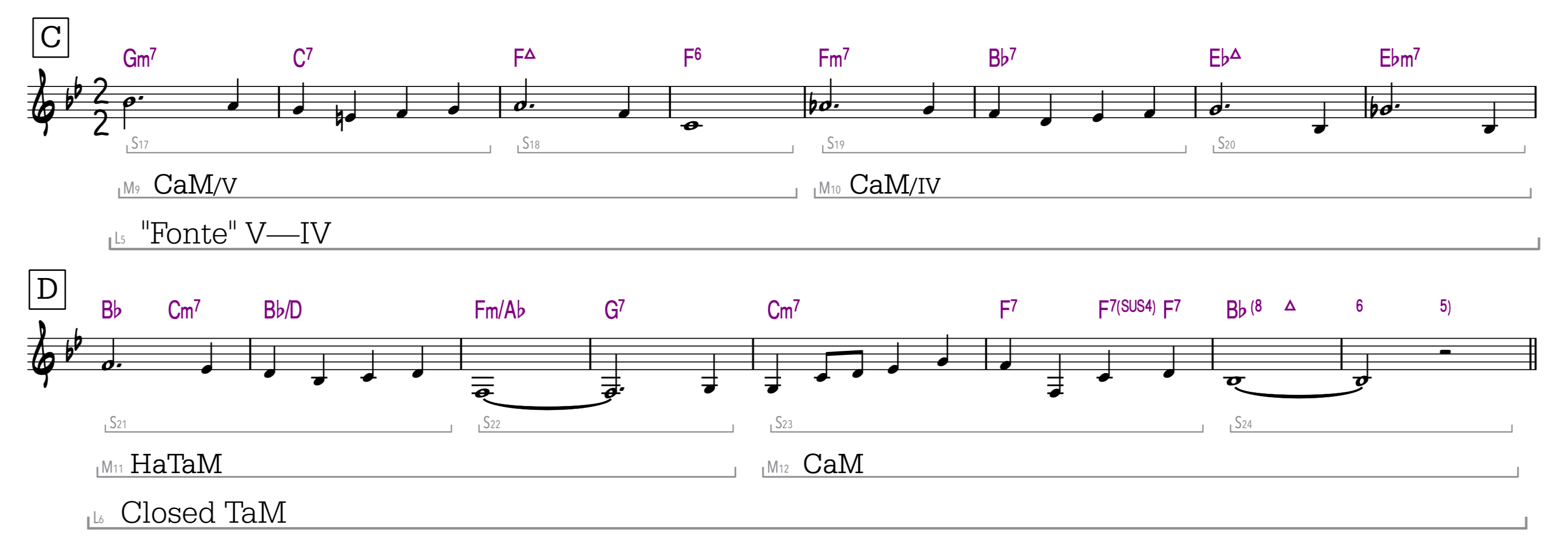
Together, the two M-sized HaTaM and TaM form an L-sized extended TaM, while the two M-sized HaCaM and CaM form an L-sized extended CaM. The C section consists of two sequential secondary CaMs—CaM/V followed by CaM/IV—a “Fonte” V—IV. The D section forms an L-sized Closed TaM.

There’s a Small Hotel
The B section (bridge) of Richard Rodgers’s There’s a Small Hotel (1936) may serve as an example of the use of secondary TaMs. The entire eight-bar strain can be considered as an elaborate HaCaM formed by a TaM/IV (S9), a modulating TaM/IV→II (S10), a TaM/II (S11), and a HaCaM (S12), which is in turn made up of two secondary XS CaMs: CaM/II (m. 23) and CaM/V (m. 24).

Appendix
The 4 Combinations of the 2 Harmonic Events in 2 Time Spans
All possibilities listed as 2-bar (S) modules:
- [ 🀰🀰 ] → [ 0—0 ] = HaTaM
- [ 🀰🀰 ] → [ 0—1 ] = TaM
- [ 🀰🀰 ] → [ 1—0 ] = CaM
- [ 🀰🀰 ] → [ 1—1 ] = HaCaM
The 16 Combinations of the 2 Harmonic Events in 4 Time Spans
All possibilities listed as 4-bar (M) modules:
- [ 🀰🀰 🀰🀰, ] → [ 0—0— 0—0—, ] = [ HaTaM—— HaTaM——, ]: HaTaM (Tonic Prolongation)
- [ 🀰🀰 🀰🀰, ] → [ 0—0— 0—1—, ] = [ HaTaM—— TaM——, ]: Extended TaM
- [ 🀰🀰 🀰🀰, ] → [ 0—0— 1—0—, ] = [ HaTaM—— CaM——, ]: Closed TaM
- [ 🀰🀰 🀰🀰, ] → [ 0—0— 1—1—, ] = [ HaTaM—— HaCaM——, ]: TaM
- [ 🀰🀰 🀰🀰, ] → [ 0—1— 0—0—, ] = [ TaM—— HaTaM——, ]: CaM (I–V—I type)
- [ 🀰🀰 🀰🀰, ] → [ 0—1— 0—1—, ] = [ TaM—— TaM——, ]: TaM—TaM
- [ 🀰🀰 🀰🀰, ] → [ 0—1— 1—0—, ] = [ TaM—— CaM——, ]: TaM—CaM (e.g. “Birthday Shuttle”)
- [ 🀰🀰 🀰🀰, ] → [ 0—1— 1—1—, ] = [ TaM—— HaCaM——, ]: Contracted TaM
- [ 🀰🀰 🀰🀰, ] → [ 1—0— 0—0—, ] = [ CaM—— HaTaM——, ]: Contracted CaM
- [ 🀰🀰 🀰🀰, ] → [ 1—0— 0—1—, ] = [ CaM—— TaM——, ]: CaM—TaM (Contracted CaM)
- [ 🀰🀰 🀰🀰, ] → [ 1—0— 1—0—, ] = [ CaM—— CaM——, ]: CaM—CaM (e.g. “Prinner”)
- [ 🀰🀰 🀰🀰, ] → [ 1—0— 1—1—, ] = [ CaM—— HaCaM——, ]: CaM—HaCaM (e.g. Open “Prinner”)
- [ 🀰🀰 🀰🀰, ] → [ 1—1— 0—0—, ] = [ HaCaM—— HaTaM——, ]: CaM (II–V—I type)
- [ 🀰🀰 🀰🀰, ] → [ 1—1— 0—1—, ] = [ HaCaM—— TaM——, ]: CaM with lower-level TaM as HaTaM
- [ 🀰🀰 🀰🀰, ] → [ 1—1— 1—0—, ] = [ HaCaM—— CaM——, ]: Extended CaM
- [ 🀰🀰 🀰🀰, ] → [ 1—1— 1—1—, ] = [ HaCaM—— HaCaM——, ]: HaCaM (Non-Tonic Prolongation)
References
- Schaap, Phil. 2016. Liner notes to Unheard Bird: The Unissued Takes, by Charlie Parker. Verve Records.
- Martin, Henry. 2018. “Four Studies of Charlie Parker’s Compositional Processes.” Music Theory Online 24, no. 2 (July). https://www.mtosmt.org/…
- Rodgers, Richard. 1975. Musical Stages: An Autobiography. New York: Random House.
- Gioia, Ted. 2012. The Jazz Standards: A Guide to the Repertoire. New York: Oxford University Press, 117.
